Research

Open-Source Software for Real-Time Electronic Structure Theory
We develop open-source software for real-time electronic structure theory. Most code can be found in the TiDES (Time-Dependent Electronic Structure) code, backended with the open-source electronic structure library PySCF and currently equipped with the ability to perform dynamics calculations using Density Functional Theory and Hartree Fock, with TiDES modularity allowing for additional calculations to be performed. Real-Time Density Matrix Embedding Theory is also available. More information can be found under Software.
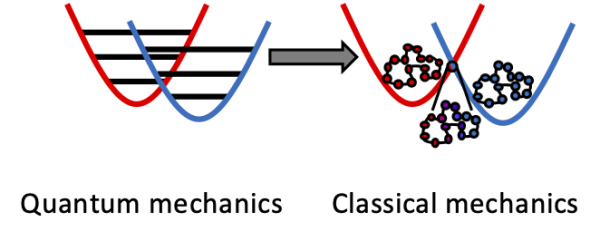
Method Development for Electron Dynamics
A large focus of the Kretchmer group is on the development of new methods for the direct simulation of electron dynamics. We work with a variety of different methods, including classically isomorphic and real-time electronic structure methods. In the former, a quantum mechanical system is mapped to a classical system, such that the underlying quantum dynamics can be treated using purely classical equations of motion. In the latter, we extend techniques from static electronic-structure theory to solve the time-dependent Schrödinger equation.
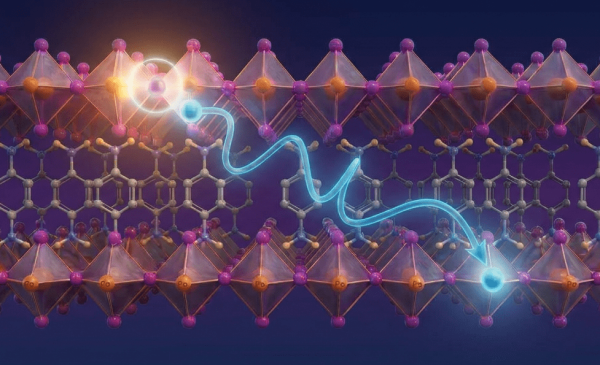
Charge and Spin Transport in Novel Material Systems
We are actively exploring charge and spin transport processes in new material systems exhibiting novel photochemical properties. In many cases, conventional theories are insufficient to describe the charge transport mechanism, due to the unique behavior of the surrounding nuclear or electronic environment. To tackle this lack of understanding, we utilize a multi-tiered simulation approach consisting of rare-event sampling techniques, path integral molecular dynamics, and innovative real-time electronic structure methods. Current interests include 3D and 2D perovskites as well as chiral-induced spin selectivity.
Real-Time Dynamics of Ultrafast Electronic Decay Mechanisms
The ionization of an inner valence or core electron can initiate competing electronic relaxation pathways that occur on the attosecond to femtosecond timescale. These include interatomic coulomb decay, in which an electron relaxes to fill the hole while simultaneously ionizing another electron on a neighboring molecule, and electron transfer mediated decay, in which an electron transfers from a neighboring molecule to fill the hole simultaneously ionizing another electron, among others. We develop and apply real-time DFT methods to directly simulate the real-time dynamics of these competing electronic decay mechanisms in molecular clusters and at surfaces.